
Gemini 4 Argon is Google DeepMind’s flagship frontier AI model, announced on September 30, 2026. Its headline change is support for generating up to 1 million output tokens in one pass, alongside integrated text, image, audio, video and code processing. The model is initially being rolled out under security controls, with wider access planned in stages.
For readers asking what is gemini 4 argon, it is a model designed for complex software engineering, enterprise document work and cybersecurity defence. The information below covers its reported capabilities, benchmarks, pricing and access status.
Gemini 4 Argon key details
| Particular | Details |
|---|---|
| Organization | Google DeepMind |
| Announcement date | September 30, 2026 |
| Model category | Frontier AI model |
| Maximum output capacity | Up to 1 million tokens in a single generation pass |
| Primary focus areas | Software engineering, enterprise knowledge work and cybersecurity defence |
| Initial access | Restricted rollout for security partners and internal Google workflows |
| Pricing | Starts around $2 per million input tokens and $10 per million output tokens |
What are the key Gemini 4 Argon features?
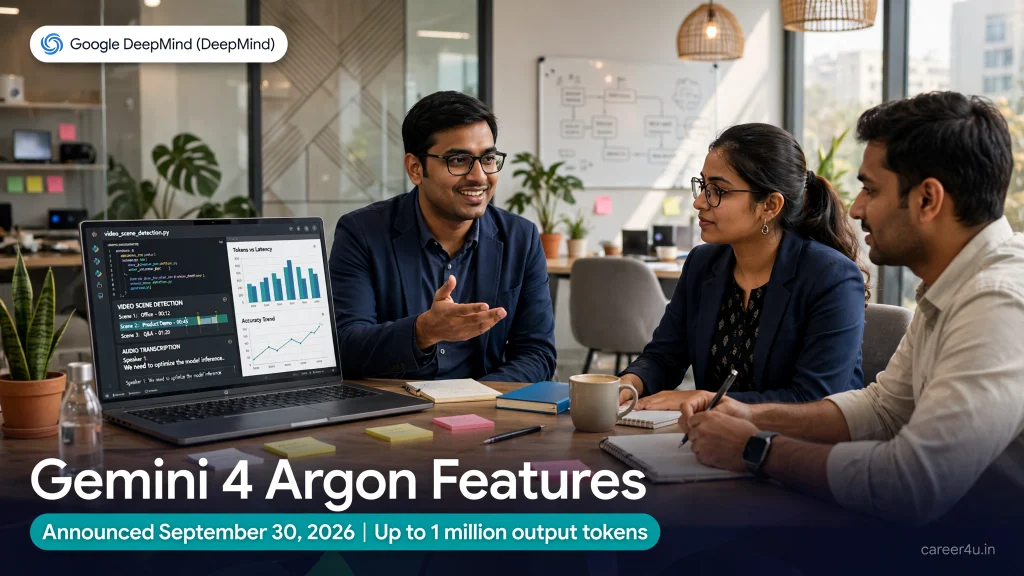
The main gemini 4 argon features include long-output generation, integrated multimodal processing and support for extended agentic tasks. Google is positioning the model for work that may require sustained analysis across large codebases, documents or long videos.
- Long outputs: gemini 4 argon 1 million output tokens refers to its stated capacity to produce up to one million tokens in a single generation pass. This is intended for multi-file code work, extensive documentation and long-form reasoning tasks.
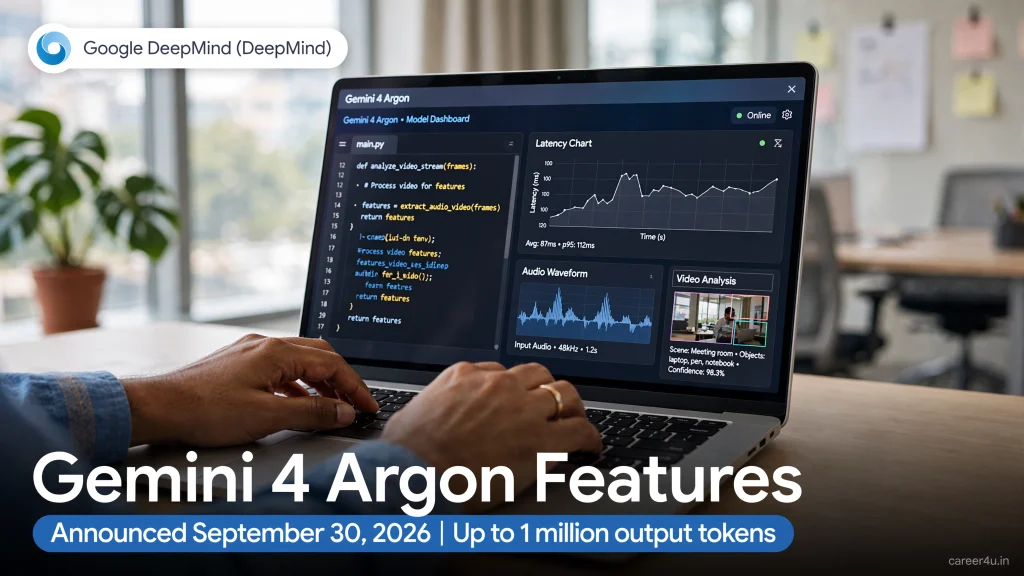
- Multimodal input: The model processes text, images, audio, video and code through a unified architecture. The source describes frame-level video understanding and chart and diagram parsing without separate preprocessing or adapter layers.
- Software engineering: Its target uses include repository migrations, multi-file coding and end-to-end agentic workflows. Google’s internal examples include rewriting legacy code blocks into memory-safe Rust.
- Enterprise analysis: It is designed to work with dense, specialised corporate, legal and financial documents.
- Cybersecurity defence: The model is trained for vulnerability assessment, code remediation and threat mitigation.
Announcement date and release status
The gemini 4 argon announcement date 2026 is September 30, 2026. If you are asking when was gemini 4 argon announced in 2026, the reported announcement was made on that date.
ALSO READ:
The gemini 4 argon release date for unrestricted public access has not been specified. At launch, Google restricted deployment because of the model’s cybersecurity capabilities. The gemini 4 argon availability described so far is a controlled rollout, beginning with trusted cyber defenders through the Fairwind Program and government pre-release review frameworks. Access is then rolling out sequentially to paid enterprise API customers and Google Cloud and Workspace channels.
That means a confirmed gemini 4 argon public release date for general users is not included in the reported details. They describe staged access rather than a single date for availability to everyone.
Benchmark performance
The reported evaluations place Argon at or near the top of several frontier-model leaderboards. The source cites an approximate score of 92% on Vibe Code Bench, alongside strong results on DeepSWE v1.1 for coding and agent tasks. It also reports high performance on Graphwalks BFS for graph reasoning and LABBench2 for scientific and biology workflows.
For video analysis, the model is described as a top-tier performer on LVBench, an evaluation focused on long-form video comprehension. These results are reported benchmarks; they do not guarantee the same performance on every task or user workflow.
Pricing
gemini 4 argon pricing starts at around $2 per million input tokens and $10 per million output tokens. Depending on the tier, the stated rates can rise to $4 per million input tokens and $20 per million output tokens. The pricing information also describes discounts of up to 95% for cached contexts. The applicable tier and final cost depend on the access plan.
Security and access controls
Google’s initial rollout prioritises trusted cyber defenders because the model can assist with both cybersecurity assessment and remediation. The reported safeguards include extensive adversarial training, with strong results on Gray Swan’s indirect prompt injection evaluation. Wider access is being introduced in stages rather than offered to all users at launch.
Antigravity access and requirements
The supplied details do not confirm gemini 4 argon in antigravity or identify Antigravity as an access channel. They also do not state specific device, operating-system or account-level gemini requirements. For access information, check the relevant Google Cloud, Workspace or API channel as its rollout progresses.
Frequently asked questions
When was Gemini 4 Argon announced?
It was announced on September 30, 2026.
How many output tokens can it generate?
It is reported to support up to 1 million output tokens in a single generation pass.
Is there a confirmed date for general public access?
No general public release date is specified. Access is rolling out in stages, starting with security partners and internal Google workflows, followed by paid enterprise API customers and Google Cloud and Workspace channels.
What is the starting price?
The stated starting rates are around $2 per million input tokens and $10 per million output tokens, with higher tiers reaching $4 and $20 respectively.
What work is Gemini 4 Argon designed for?
Its main focus areas are long-horizon software engineering, enterprise knowledge work and cybersecurity defence. It also supports multimodal tasks involving text, images, audio, video and code.
Where can I verify the latest access details?
The source information identifies Google DeepMind but does not provide an official announcement URL. Check Google’s official channels for current availability, pricing tiers and access terms before relying on them.