
UPPCS Prelims Subject-Wise Weightage 2026 : Understanding the UPPCS Prelims subject-wise weightage 2026 can help candidates plan their preparation for the Uttar Pradesh Public Service Commission (UPPSC) PCS examination. The preliminary exam has two papers: General Studies Paper 1 and CSAT Paper 2. General Studies Paper 1 is important for merit in the selection process, while CSAT is qualifying.
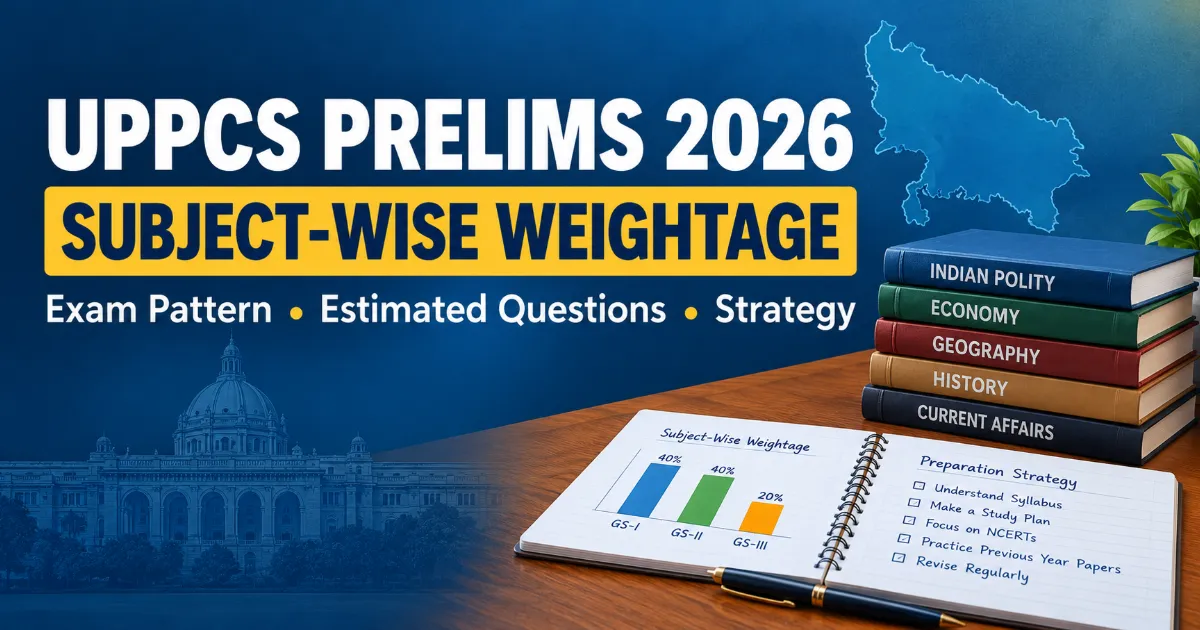
The subject-wise question ranges below are estimates based on analysis of previous question papers. UPPSC does not guarantee a fixed number of questions from any subject, so use the figures as a guide—not as a prediction of the next paper. Candidates should prepare according to the syllabus and make time for revision and practice.
UPPCS Prelims Exam Pattern 2026
| Exam detail | General Studies Paper 1 | CSAT Paper 2 |
|---|---|---|
| Total questions | 150 | 100 |
| Maximum marks | 200 | 200 |
| Duration | 2 hours | 2 hours |
| Question type | Objective (MCQ) | Objective (MCQ) |
| Role in the exam | Important for merit for the Main Examination | Qualifying paper; candidates need at least 33% |
| Negative marking | 1/3 mark deducted for a wrong answer | 1/3 mark deducted for a wrong answer |
Use the PCS preliminary examination page to explore the exam, and practise with the UPPCS mock test series.
UPPCS Prelims Subject-Wise Weightage 2026: Estimated Questions
The following distribution is an indicative estimate for General Studies Paper 1, based on previous-paper analysis. The ranges are not fixed allocations, and the number of questions from each subject can vary from year to year.
ALSO READ:
| Subject | Estimated number of questions |
|---|---|
| History and Indian National Movement | 18–25 |
| Indian and World Geography | 18–25 |
| Indian Polity and Governance | 18–24 |
| Current Affairs and General Awareness | 20–30 |
| Economy and Social Development | 10–16 |
| General Science and Technology | 12–20 |
| Environment and Ecology | 7–12 |
| Uttar Pradesh-specific General Knowledge | 5–12 |
| Total questions in General Studies Paper 1 | 150 |
The subject ranges are estimates and should not be added as a fixed question-by-question blueprint. The paper has 150 questions overall, and the actual subject distribution can change.
Subject-Wise Preparation Strategy for UPPCS Prelims
History and the Indian National Movement
History covers ancient, medieval and modern India, along with the Indian National Movement. Focus on understanding the order and significance of events, not just memorising names and dates.
- Ancient Indian civilisations, religions and major dynasties.
- The Maurya, Gupta and other important dynasties.
- The Delhi Sultanate and Mughal period.
- The Revolt of 1857 and its major centres.
- The establishment of the Indian National Congress and the national movement.
- Gandhian movements, revolutionary activities and the achievement of independence.
- Historical events and personalities associated with Uttar Pradesh.
Preparation tip: Give particular attention to modern history and the freedom movement. Revise important ancient and medieval history facts and practise previous-year questions.
Indian and World Geography
Geography can cover physical, social and economic topics. Prepare Indian and world geography alongside the geography of Uttar Pradesh. Map-based questions, rivers, minerals and geographical features are useful areas to practise.
- Earth’s internal structure and landforms.
- The Indian monsoon, climate and rainfall.
- Indian rivers, lakes and irrigation projects.
- Mountains, plateaus, plains and important passes.
- Agriculture, mineral resources and industries.
- World geography and major geographical locations.
- Uttar Pradesh’s rivers, soils, agriculture and natural resources.
Preparation tip: Study NCERT books and practise regularly with an atlas. Locate rivers, national parks, mineral regions and important places on maps.
Indian Polity and Governance
Polity includes the Constitution, fundamental rights, Parliament, the President, state-level institutions, the judiciary and constitutional bodies. Focus on understanding what institutions do and how constitutional provisions work.
- Key features of the Indian Constitution.
- Fundamental Rights, Fundamental Duties and Directive Principles of State Policy.
- The President, Prime Minister and Council of Ministers.
- Parliament and state legislatures.
- The Supreme Court and High Courts.
- The Election Commission, Finance Commission and other constitutional bodies.
- Panchayati Raj, local governance and public policies.
Preparation tip: Understand important constitutional articles, amendments and institutional functions. Practise statement-based questions instead of relying only on memorisation.
Current Affairs and General Awareness
Current affairs can connect with static subjects. For example, a question about an environmental agreement, government scheme or economic report may require knowledge of both the recent development and the related subject.
- National and international events.
- Major schemes of the Union and Uttar Pradesh governments.
- Important appointments and awards.
- Sports competitions and achievements.
- Government reports, indices and surveys.
- Developments in science, space and defence.
- Environmental conferences and international organisations.
Preparation tip: Follow current affairs regularly and revise monthly compilations. Revisit both recent events and older developments that have remained in the news.
Economy and Social Development
Economy questions may test basic concepts as well as understanding of government policies and social development. Study foundational topics alongside current economic developments.
- GDP, national income and economic growth.
- Inflation, unemployment and poverty.
- The Indian banking system and the Reserve Bank of India (RBI).
- The Union Budget and Economic Survey.
- Agriculture, industry and the services sector.
- Financial inclusion and government schemes.
- Uttar Pradesh’s economy, agriculture and major industries.
Preparation tip: Start with basic economic concepts, then study relevant facts from the Budget, Economic Survey and important government schemes.
General Science and Technology
General science may include everyday scientific principles as well as topics from physics, chemistry, biology and technology. Build a sound grasp of the basics before moving to relevant current affairs.
- Human body, nutrition and major diseases.
- Cells, genetics and plant science.
- Motion, force, energy and light.
- Metals, non-metals, acids and bases.
- Vaccines, health and biotechnology.
- Space missions and modern technology.
Preparation tip: Begin with NCERT Science books from Classes 6 to 10, then cover important science and technology current affairs.
Environment and Ecology
Environment questions may cover biodiversity, ecosystems, pollution, climate change and conservation. Prepare core concepts and keep up with relevant current affairs.
- Ecosystems and food chains.
- Biodiversity and conservation.
- National parks and wildlife sanctuaries.
- Climate change and global warming.
- Pollution and environmental agreements.
- Ramsar sites and international environmental organisations.
Preparation tip: Understand key environmental concepts and regularly revise protected areas, national parks and environment-related news.
Uttar Pradesh-Specific General Knowledge
Do not overlook Uttar Pradesh-specific topics. Questions may test knowledge of the state’s history, geography, culture, economy, administration and schemes.
- Uttar Pradesh’s history and cultural heritage.
- Major rivers, districts and geographical features.
- Folk dances, fairs, festivals and famous places.
- The state’s economy, agriculture and industries.
- State government schemes and the state budget.
- Major institutions, tourist destinations and recent state-level events.
Preparation tip: Keep separate notes for Uttar Pradesh topics. Update them with information on state schemes, the economic survey and significant current events.
Suggested Study-Time Allocation by Subject
The source suggests the following division of preparation time. Treat it as a starting point and adjust it according to your available time, strengths and weaker areas.
| Subject | Suggested share of study time |
|---|---|
| History | 15% |
| Geography | 15% |
| Indian Polity | 15% |
| Current Affairs | 20% |
| Economy | 10% |
| General Science | 10% |
| Environment | 7% |
| Uttar Pradesh-specific topics | 8% |
How to Use Previous-Year Papers and Mock Tests
Previous-year papers can help you understand question formats, difficulty levels and recurring areas. They are also useful for checking whether your preparation is translating into accurate answers under timed conditions.
- Browse UPPCS previous-year papers.
- Download the UPPCS Prelims General Studies question paper PDF.
- Download the UPPCS Prelims CSAT question paper PDF.
- Download the UPPSC Prelims Direct Hit Questions PDF.
- Practise UPPCS CSAT previous-year papers.
UPPCS Prelims Preparation Tips
- Solve previous-year papers: Practise papers from the past 5–10 years to review question patterns, difficulty and important topics.
- Follow the syllabus: Use the UPPSC syllabus to organise your preparation and make a list of topics for each subject.
- Revise consistently: Revisit important facts in history, geography, polity and current affairs at regular intervals.
- Take mock tests: Attempt tests within the allotted time and review your mistakes to identify topics that need more work.
- Account for negative marking: Read questions carefully and assess the options before answering, as wrong answers carry a penalty.
- Prepare for CSAT too: Practise mathematics, reasoning, Hindi and English comprehension, and other prescribed topics. CSAT requires at least 33% to qualify.
UPPCS Prelims Subject-Wise Weightage 2026: FAQs
Which subject has the highest weightage in UPPCS Prelims?
The number of questions can change each year. History, geography, Indian polity and current affairs are among the key areas identified in the estimated distribution, so candidates should prepare all of them.
How many questions are there in UPPCS Prelims?
General Studies Paper 1 has 150 questions, and CSAT Paper 2 has 100 questions.
Are CSAT marks included in the UPPCS Prelims merit calculation?
CSAT is a qualifying paper, and candidates need at least 33%. General Studies Paper 1 is important for merit for the Main Examination.
How should I prepare current affairs for UPPCS Prelims?
Study daily news and monthly current-affairs material, including government schemes, important reports and current events from Uttar Pradesh.
Are Uttar Pradesh-specific questions asked in UPPCS Prelims?
Questions may cover Uttar Pradesh’s history, geography, culture, economy, administration and government schemes.
Why are previous-year papers useful for UPPCS Prelims?
They help candidates understand question formats, difficulty levels and important topics, and provide a way to assess preparation.