
The 2026 Guide to Mastering AI : Artificial intelligence is becoming an important part of how people learn, work, create content, analyze information and build digital products. But mastering AI is not simply about knowing how to use the latest AI tool.
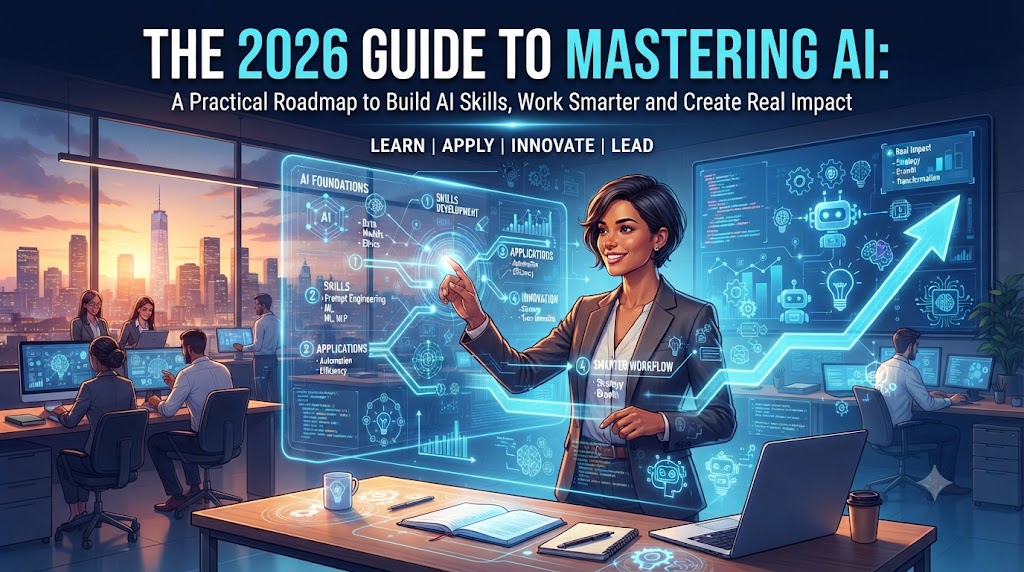
The real skill is knowing what problem to solve, which AI tool to use, how to give good instructions, how to check the output and how to combine AI with human judgment.
This 2026 AI roadmap provides a practical way to build useful AI skills step by step. It covers AI fundamentals, prompt engineering, AI tools, practical applications, responsible AI and habits that can help you continue learning.
1. Start With AI Fundamentals : The 2026 Guide to Mastering AI
Before experimenting with advanced AI tools, it is important to understand the basics.
ALSO READ:
You do not need to become an AI researcher or machine-learning engineer to benefit from artificial intelligence. However, understanding the basic concepts helps you use AI more effectively.
Start by learning:
- What is Artificial Intelligence?
- How does AI work?
- What are the different types of AI?
- What is Generative AI?
- What are Large Language Models (LLMs)?
- What are prompts?
- What are AI agents?
- What are machine learning and deep learning?
- What are the limitations of AI?
A basic understanding of these terms makes it easier to evaluate new AI products and understand what they can and cannot do.
Why AI fundamentals matter
AI tools change quickly. A tool that is popular today may be replaced by another tool tomorrow.
If you only learn one particular application, your knowledge may become outdated. If you understand the principles behind AI, you can adapt to new tools much more easily.
2. Develop Core AI Skills
Once you understand the basics, the next step is learning how to work effectively with AI.
Prompt Engineering
Prompt engineering is the process of giving AI clear instructions so that it can produce more useful results.
A good prompt generally explains:
- What you want
- Why you need it
- Important background information
- Your target audience
- Required format
- Limitations or rules
- Examples when necessary
Instead of asking:
“Write an article about AI.”
You could provide more useful instructions:
“Write a simple English article explaining how beginners can learn AI in 2026. Include practical examples, common mistakes, useful AI skills and a short FAQ.”
The second request gives the AI much more context.
Remember: Good Input = Better Output
AI output depends heavily on the quality of the information and instructions you provide.
If the input is unclear, incomplete or incorrect, the result may also be poor.
This is often described as:
Garbage in, garbage out.
3. Learn to Use AI Tools Effectively
There are many AI tools available for writing, research, coding, design, productivity, data analysis and education.
The goal should not be to learn every new AI tool.
Instead, learn how to choose the right tool for the right problem.
For example:
| Task | Useful AI Capability |
|---|---|
| Writing ideas | Generative AI |
| Research assistance | AI research tools |
| Coding | AI coding assistants |
| Data analysis | AI-powered data tools |
| Presentations | AI presentation tools |
| Images | AI image generation |
| Productivity | AI assistants and automation |
| App development | AI coding and development tools |
Google’s AI ecosystem also includes tools such as Gemini, NotebookLM, Google AI Studio, Google Docs, Google Sheets and Google Slides, which can be useful for learning, research and productivity.
4. Use AI for Research and Communication
AI can help with research, but it should not automatically be treated as a source of truth.
You can use AI to:
- Generate research questions
- Summarize information
- Organize ideas
- Compare concepts
- Explain difficult topics
- Create outlines
- Improve writing
- Prepare presentations
- Brainstorm solutions
However, important facts should be checked against reliable and authoritative sources.
This is especially important when working with:
- Government information
- Recruitment notifications
- Financial information
- Legal information
- Medical information
- Academic research
- Technical specifications
- Current events
AI can make mistakes, misunderstand context or provide information that sounds convincing but is incorrect.
5. Apply AI to Real-World Problems
Learning AI becomes more valuable when you start using it for practical tasks.
The roadmap highlights several important areas.
AI for Content Creation
AI can help with:
- Article planning
- Content outlines
- Social media ideas
- Editing
- Summarization
- Email drafting
- Video scripts
- Educational materials
The human should still provide experience, originality, fact-checking and final judgment.
AI for Data Analysis
AI can assist with:
- Understanding spreadsheets
- Finding patterns
- Summarizing datasets
- Creating reports
- Generating charts
- Explaining statistics
Users should verify important calculations and conclusions rather than accepting every result automatically.
AI for Productivity Automation
AI can reduce repetitive work by helping with:
- Document preparation
- Information organization
- Email drafts
- Task planning
- Data processing
- Workflow automation
The objective should be creating more value, not simply automating everything.
AI for Business
Businesses can explore AI for:
- Customer support
- Marketing
- Content production
- Data analysis
- Internal documentation
- Sales assistance
- Process automation
The best AI implementation starts with a genuine business problem rather than using AI simply because it is popular.
Build AI-Powered Applications
For developers, AI creates opportunities to build applications that can:
- Understand text
- Analyze documents
- Generate content
- Answer questions
- Process images
- Assist users
- Automate repetitive tasks
Learning programming together with AI can therefore become a valuable combination.
6. Test, Evaluate and Improve AI Results
One of the most important AI skills is evaluation.
Do not assume that the first response is the best response.
A useful workflow is:
Prompt → Test → Evaluate → Improve → Verify
If the response is not useful, identify what is wrong.
Ask:
- Is the information accurate?
- Did AI understand the question?
- Are important details missing?
- Is the response too general?
- Are there unsupported claims?
- Can the prompt be improved?
- Does the final result meet the actual requirement?
This iterative approach can significantly improve the quality of AI-assisted work.
7. Human Judgment Still Matters
AI can process information quickly, but human judgment remains important.
A strong approach is:
AI Strengths + Human Strengths = Better Results
AI can help with speed, brainstorming, pattern recognition and repetitive tasks.
Humans contribute:
- Experience
- Context
- Creativity
- Ethics
- Critical thinking
- Decision-making
- Empathy
- Responsibility
Instead of asking whether AI will replace humans, a more useful question is:
How can humans use AI to become more capable?
8. Responsible AI: Privacy, Bias and Ethics
AI should be used responsibly.
Protect Private Information
Think carefully before entering sensitive information into an AI system.
Avoid unnecessarily sharing:
- Passwords
- Banking information
- Personal identification documents
- Private customer information
- Confidential business documents
- Sensitive personal data
Always understand how a particular AI service handles the information you provide.
Watch for Bias
AI systems can sometimes produce biased or incomplete results because their outputs depend on their training, instructions and context.
For important decisions, human review is essential.
Use AI Ethically
AI should support productive and responsible work.
Avoid using AI for:
- Deception
- Fraud
- Harmful activities
- Misleading content
- Unauthorized use of private information
Responsible AI use is not just about technology. It is also about how people choose to use that technology.
9. What You Should Avoid When Learning AI
The AI roadmap highlights several common mistakes.
Relying 100% on AI
AI should be an assistant, not your replacement for thinking.
Copying Without Understanding
If AI generates code, an article, an explanation or an analysis, understand what you are using.
Ignoring Fact-Checking
A confident-looking AI answer can still contain errors.
Sharing Private Data
Think before putting sensitive information into an AI tool.
Overcomplicating Prompts
A prompt does not need to be extremely complicated. Clear instructions and useful context are usually more important.
Expecting Perfect Results Every Time
AI output often requires revision.
Chasing Every New AI Tool
There is no need to install or learn every new AI product that appears.
Choose tools that actually solve your problems.
Ignoring the Basics
Strong fundamentals remain valuable even when AI tools become more advanced.
10. Develop Better AI Learning Habits
Mastering AI is a continuous process.
Instead of trying to learn everything in one week, develop consistent habits.
Build These Habits
- Practice AI every day
- Stay curious
- Experiment with different approaches
- Save useful prompts
- Document what you learn
- Review your results
- Improve your prompts
- Share knowledge with others
- Follow important AI developments
Even 20–30 minutes of practical AI learning every day can become valuable over time.
Kill These Habits
Try to reduce:
- Procrastination
- Staying inside your comfort zone
- Information overload
- Mindless scrolling
- Ignoring useful feedback
Learning AI is more effective when you practice instead of only consuming information.
11. Develop the Right AI Mindset
Technical knowledge is only one part of becoming good at AI.
The right mindset is equally important.
Be Curious
Ask questions and explore how AI can solve everyday problems.
Embrace Experimentation
Try different prompts and approaches. Not every experiment will work, and that is part of learning.
Focus on Problems
Start with:
“What problem am I trying to solve?”
Then decide which AI tool can help.
Think in Systems
Instead of using AI for one isolated task, think about how it can improve an entire workflow.
Keep Learning
AI technology changes quickly. Continuous learning is one of the most important long-term skills.
Take Action
Reading about AI is useful, but building something with AI provides much deeper learning.
12. A Simple AI Learning Roadmap for Beginners
If you are completely new to AI, you can follow this progression:
Step 1: Learn the Basics
Understand AI, Generative AI, machine learning, LLMs and common AI terminology.
Step 2: Learn Prompting
Practice writing clear instructions and providing useful context.
Step 3: Explore AI Tools
Try AI tools for writing, research, coding, images, productivity and data.
Step 4: Solve Small Problems
Use AI to improve something you already do regularly.
Step 5: Build a Project
Create a small website, application, automation or useful workflow.
Step 6: Evaluate the Results
Check accuracy, usefulness, limitations and potential risks.
Step 7: Improve
Modify your prompts and workflow based on what you learn.
Step 8: Keep Learning
Follow meaningful AI developments without feeling the need to chase every new tool.
AI Skills That Can Become Valuable in 2026
The most useful AI skills are not limited to prompt writing.
Consider developing a combination of:
- AI literacy
- Prompt engineering
- Critical thinking
- Research and fact-checking
- Data analysis
- AI-assisted coding
- Automation
- Content creation
- Problem-solving
- AI ethics
- Privacy awareness
- Communication
- Domain-specific knowledge
The strongest combination is often AI knowledge + an existing professional skill.
For example:
Teacher + AI → AI-assisted education
Developer + AI → AI-powered applications
Marketer + AI → AI-assisted marketing
Writer + AI → Faster research and content workflows
Business owner + AI → Process automation and analysis
Will AI Replace Every Job?
AI is changing many types of work, but the future is more complicated than simply saying that AI will replace every job.
Many roles are likely to change as AI takes over certain repetitive tasks.
This means workers may need to learn how to work with AI rather than compete against it.
The key message is simple:
AI may not replace every person, but people who know how to use AI effectively can have an advantage over those who do not.
That makes continuous learning increasingly important.
Frequently Asked Questions About Mastering AI
1. What is the best way to start learning AI in 2026?
Start with AI fundamentals, then learn prompt engineering and experiment with a few useful AI tools. Move quickly from theory to practical projects.
2. Do I need programming knowledge to learn AI?
No. Beginners can learn AI tools without programming. However, programming skills can become very valuable if you want to build AI-powered applications.
3. What is prompt engineering?
Prompt engineering means creating clear and effective instructions for an AI system to produce a useful result.
4. Should I learn every new AI tool?
No. Focus on tools that solve real problems in your work, education or business.
5. Can AI-generated information always be trusted?
No. AI can make factual errors. Important information should be verified using reliable sources.
6. How can I become better at using AI?
Practice regularly, experiment with prompts, evaluate the results and learn from mistakes.
7. Is AI useful for students?
Yes. Students can use AI for learning concepts, brainstorming, research assistance, writing support, coding practice and study planning, while still doing their own thinking and verifying important information.
8. What is the most important AI skill?
There is no single skill for everyone. A combination of AI literacy, critical thinking, good prompting, fact-checking and problem-solving provides a strong foundation.
Final Thoughts
Mastering AI in 2026 is not about becoming an expert in every new artificial intelligence tool. It is about developing the ability to identify problems, choose appropriate tools, communicate clearly with AI, evaluate results and make responsible decisions.
Start with the fundamentals. Practice with real problems. Build small projects. Check the information AI provides. Keep improving your prompts and workflows.
Most importantly, do not let AI replace your curiosity or judgment.
Learn AI. Experiment with AI. Build with AI. But always keep human thinking at the center.
The future belongs not only to people who use AI, but to people who know how to use it thoughtfully and effectively.